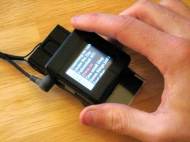
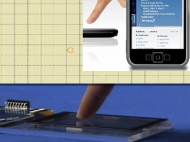
By installing a pair of optical sensors on the back of a mobile phone or mp3 player, the researchers at Carnegie Mellon University found that the entire device could have many of the same benefits as that of a computer mouse when the device was placed against a surface, a piece of clothing or the…
»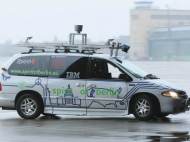
German researchers have developed a new technology that lets drivers steer cars using only their eyes. The scientists Berlin’s Free University developed the software eyeDriver which is responsible for the steering of their car dubbed “Spirit of Berlin” just by the movement of the eyes. Raul Rojas, an artificial intelligence researcher at Berlin’s Free University,…
»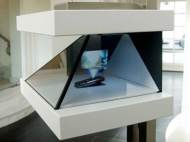
We may not have true holographic displays for several years yet, but in the meantime, there are plenty developers around the world willing to provide us with something that gives the appearance of those. In our previous articles we already wrote about few solutions, and in this article we’re going to describe Dreamoc – a…
»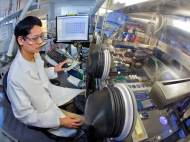
Berkeley Lab scientists have made a nanocrystal-making robot, capable of producing nanocrystals with amazing precision. This robot, named WANDA (Workstation for Automated Nanomaterial Discovery and Analysis), provides colloidal nanocrystals with custom-made properties for electronics, biological labeling and luminescent devices. Since it is controlled by software protocols, it simplifies the process to novice users without extensive…
»
The folks at Davis Frame Co., a timber frame home company based out of New Hampshire, recently built an off-grid home in Oregon. The large, 265 square meters (2,850 square feet) home is looking quite traditional, however, it was built with a great deal of green features in order to receive the Platinum certification from…
»
Cypress Semiconductor Corp. announced support for hover detection for their capacitive touchscreen technology. The new feature, driven by Cypress’s TrueTouch, enables smart touchscreen solutions that anticipate the touch of a finger and enlarge content such as points on a map or the font of tiny website links to make them easier to find and select….
»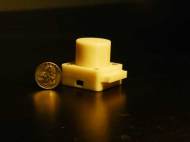
UCLA engineer Aydogan Ozcan, inventor of a novel lensless imaging technology known as LUCAS (Lensless Ultra-wide-field Cell Monitoring Array platform based on Shadow imaging), has now taken his work a step further by creating a miniature microscope – the world’s smallest and lightest for telemedicine applications. You can find more information in a paper published…
»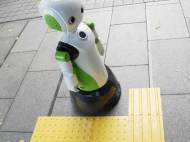
We already wrote about Robovie-II robot – designed to assist the elderly and disabled in everyday task. Japanese start-up Vstone and Advanced Telecommunications Research Institute International (ATR), have launched a new half-size humanoid robot designed for the same purpose and they named it Robovie3. The robot is much improved, yet cheaper than its predecessor. Robovie…
»