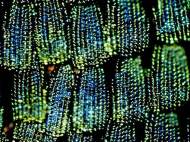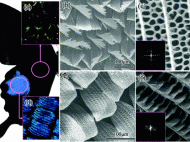
If a ship is anchored for longer periods of time, local algae, shells and barnacles colonize its hull and cause biofouling. Biofouling causes large economic losses since its growth on water vehicle hulls causes corrosion as well as higher fuel consumption. While some research groups develop surfaces which deny the initial formation, a group of…
»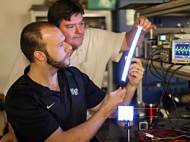
Researchers at Wake Forest University have managed to achieve a significant improvement of lighting based on field-induced polymer electroluminescent (FIPEL) technology. According to its developers, FIPEL lighting provides flicker-free soft white light and it is a shatterproof alternative for large-scale lighting with double efficiency of compact fluorescent (CFL) bulbs and on par efficiency of LED…
»
An interdisciplinary team of researchers consisting out of civil and environmental engineers, mathematicians, biomedical engineers and musical composers from MIT, Tuffs University and Boston University, cooperated in order to develop a novel method that can be used to synthesize new variants on silk’s natural structure as well as for making further improvements in the synthetic…
»
Biologists at UC San Diego have genetically engineered marine algae to produce five different kinds of industrially important enzymes in fresh water, and they claim that the same process could be used to enhance the yield of petroleum-like compounds from algae grown in salt water. This approach would allow biofuel production in the ocean or…
»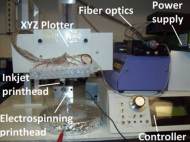
The printing of 3D tissue has taken a major step forward with the creation of a novel hybrid printer that simplifies the process of creating implantable cartilage. Researchers from the Wake Forest Institute for Regenerative Medicine were able to use this technology in order to create cartilage constructs that could eventually be used to replace…
»
A couple of years ago I stumbled onto news about EcoBot – a robot able to operate within an enclosed environment by using food, water and air found around it. However, the idea of robots which consume unrefined biomass in order to operate didn’t allure me from the ethical point of view and that news…
»
Harvard University researchers have developed a biocompatible sponge made out of a gel-based material that can be molded into any shape and compressed to a small fraction of its size. This ability allows it to be delivered via injection and restore its original shape and size while gradually releases its cargo. Since it is biocompatible…
»
Researchers at the National Institute for Materials Science (NIMS) of Japan cooperated with researchers at the RIKEN Nanoscience Joint Laboratory to develop a metal oxide film transistor which utilizes a material with newly developed atomic composition. The new composition brings the use of potential amorphous silicon transistors successors in next-generation consumer displays a step closer…
»