
Biomimicry of bees and the insect’s hive behavior – RoboBees
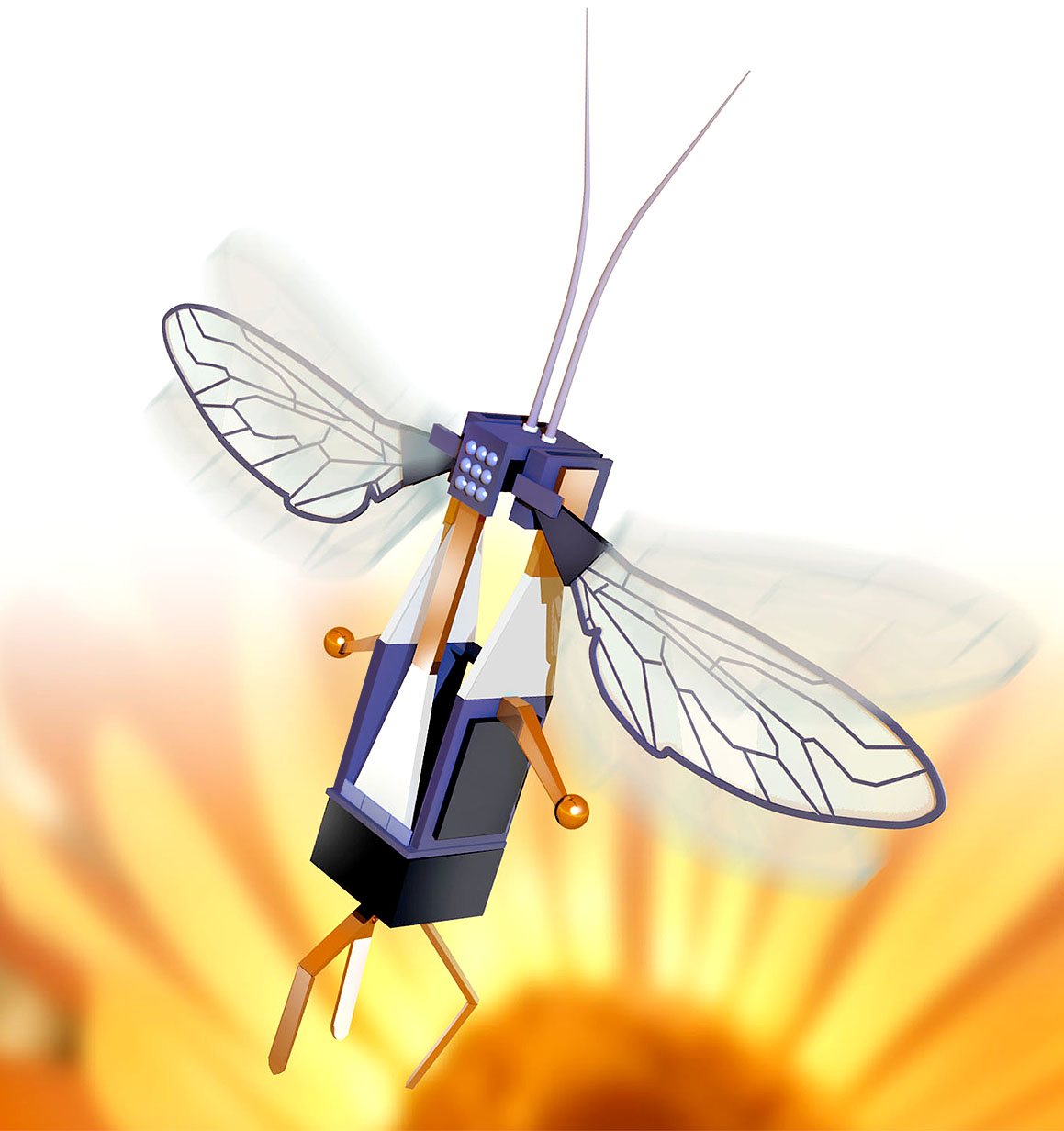 From flies to fish to lobsters, small insects and animals have long been ideal models for robotic and computer scientists. Bees, for example, possess unmatched elegance in flight, zipping from flower to flower with ease and hovering stably with heavy payloads. A multidisciplinary team of computer scientists, engineers, and biologists at Harvard received a 10 million dollars grant from National Science Foundation (NSF) Expeditions in Computing for the development of RoboBees, a colony of small-scale mobile robotic devices.
The collaborators envision that the Nature-inspired research could lead to a greater understanding of how to artificially mimic the collective behavior and “intelligence” of a bee colony; foster new methods for designing and building an electronic surrogate nervous system able to skillfully sense and adapt to changing environments; and advance work on the construction of small-scale flying mechanical devices. The researchers anticipate the devices will open up a wide range of discoveries and practical innovations, advancing fields ranging from entomology and developmental biology to amorphous computing and electrical engineering.
By leveraging existing breakthroughs from Professor Robert Wood’s Microrobotics Lab, which conducted the first successful flight of a life-sized robotic fly in 2007, the team will explore ways to emulate such aerobatic feats in their proposed devices. In addition, achieving autonomous flight will require compact high-energy power sources and associated electronics, integrated seamlessly into the ‘body’ of the machine.
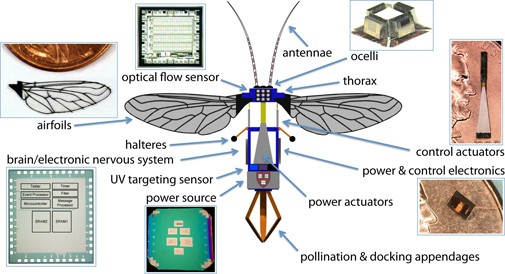
The robotic platform for the colony of artificial bees will be designed using principles derived from insect biomechanics and the fluid dynamics of flapping wings. Proper design of all mechanical and aeromechanical components of the robotic bee are crucial, since propulsive efficiency will determine flight time, and payload limitations will determine the size and mass available for sensing, communication, and other on-board electronics. However, unlike the real bees, scientists confirm that the robots will not have stingers.
Similarly, actuator power requirements necessitate the development of efficient drive electronics, and require portable power sources with high energy-to-weight ratios. Therefore, a rigorous study of the coupled mechanics and aerodynamics of an insect-scale vehicle is essential to the success of this project.
One of the most complicated areas of exploration will be the creation of a suite of artificial “smart” sensors, similar to bee’s eyes and antennae. Professor Gu-Yeon Wei explains that the ultimate aim is to design dynamic hardware and software that serves as the device’s ‘brain,’ controlling and monitoring flight, sensing objects such as fellow devices and other objects, and coordinating simple decision-making.
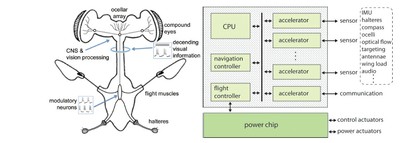
This will include sensors for proprioception and exteroception, an electronic nervous system (ENS), and control algorithms. The research of the RoboBee brain will be focused on computationally-efficient control, compact and efficient sensors, and energy-efficient electronic hardware.
In order to mimic the sophisticated behavior of a real colony of insects, the research will involve the development of sophisticated coordination algorithms, communications methods (i.e., the ability for individual machines to ‘talk’ to one another and the hive), and global-to-local programming tools to simulate the ways groups of real bees rely upon one another to scout, forage, and plan.
Coordinated behavior by the colony has the potential to dramatically increase effectiveness over each RoboBee operating independently. This requires new approaches for robust communication, coordination algorithms, and new models for programming the colony as a whole. The RoboBees colony shares characteristics with sensor networks, robot swarms, and modular robots. In all of these systems, the goal is to achieve high-level robustness from individuals with limited resources and reliability.
The investigators, primarily based at Harvard’s School of Engineering and Applied Sciences (SEAS), will coordinate efforts with faculty from the Department of Organismic and Evolutionary Biology in the Faculty of Arts and Sciences at Harvard and Northeastern University’s Department of Biology. In addition, Centeye, a microelectronics firm in Washington, D.C., specializing in vision chip and visual sensor technology, will contribute technical knowledge. A number of the collaborators are core faculty members of the newly created Wyss Institute for Biologically Inspired Engineering. As the work fits particularly well with Wyss’s mission of “creating new materials and devices using Nature’s design principles,” the Institute, along with SEAS, will play a critical role in supporting the research, providing laboratory space and in-kind financial support.
The team will also create an interactive exhibit in the Museum of Science, Boston, in order to teach and inspire future scientists and engineers.
Share:

-
-
-
-
-
-


Indeed Biomimic offers unlimited innovations in Computer applications.
Kudos to biologists at Harvard for their wonderful work.
Dr.A.Jagadeesh Nellore(AP),India
More and more applications of Biomimicry especially in Computers. Alas We have to turn to NATURE to solve COMPLEX Problems with SIMPLE solutions!
Dr.A.Jagadeesh Nellore(AP),India