By Damir B.
15 December 2011

A research team from Harvard University developed an array of “soft” robots inspired by natural forms, such as squid and starfish, which are capable to perform very delicate operations or move where rigid robots might not. These abilities enable the robots to pick up a raw egg without breaking the shell, or aid in search ... »
By Damir B.
One Comment9 December 2011

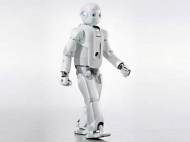
Although it was originally released in 2005 as a robot meant for entertainment, the first time we wrote about little robot NAO was in 2009 in our article about 2009 RoboCup. Aldebaran Robotics recently surprised us and released a new and improved version of the NAO robot they dubbed NAO Next Gen. NAO Next Gen ... »
By Damir B.
One Comment5 December 2011

A group of researchers from Swiss Federal Institute of Technology in Lausanne (EPFL) had a goal to create an original pedagogical tool that could be used for practical introduction of technology and robotics to children. In collaboration with the University of Art and Design Lausanne (ECAL), they developed Thymio II – a small programmable robot ... »
By Damir B.
One Comment3 December 2011

With each day, robots are becoming more popular and affordable, and they find new applications in various fields such as aid in manual labor or entertainment. Robots use in architecture hasn’t been around aside performing such tasks in video games and science fiction, but professorship of Gramazio & Kohler plans to change that fact and ... »
By Damir B.
One Comment23 November 2011

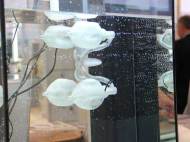
Engineers at Virginia Polytechnic Institute and State University (VirginiaTech) have used inspiration from nature and developed a robot whose design and motion patterns resemble moon jellyfish (Aurelia aurita). Named Robotjelly, the robot was developed for the U.S. Office of Naval Research back in 2009, and its latest improved iteration was presented at the 2011 meeting ... »
By Damir B.
2 Comments22 November 2011

In our previous articles, we already wrote about many examples of swarm robotics, but the researchers from Harvard University stand out by its design simplicity and low cost which is suitable in experiments related to algorithms developed for robotic swarms. Their goal to create a platform that could be produced quickly and inexpensively to form ... »
By Damir B.
14 November 2011

In the early 1980s, the industry was in need for a new type of robot capable to manipulate light and small objects at a very high speed. Since necessity is the mother of invention, Reymond Clavel from the École Polytechnique Fédérale de Lausanne (EPFL) committed to find a solution and came up with the Delta ... »