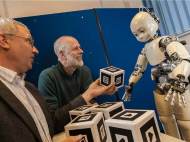
Researchers at Technical University of Munich (TUM) are developing an artificial skin for robots to help them navigate in their environments. It will provide important tactile information to the robot and thus supplement its perception formed by camera eyes, infrared scanners and gripping hands. They have built a single robotic arm equipped with sensors to ... »

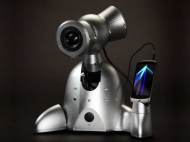
In one of our mini-series we started a while ago, we wrote about robotic vacuum cleaners that could take the throne from the ruler of that niche. In this article we’re going to write about LG RoboKing’s successor named Hom-Bot Smart Vacuum Cleaning Robot. The robot is developed for the European market, and it’s much better ... »

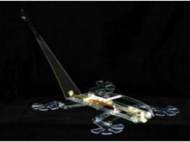
A doctoral student from EPFL’s Laboratory of Robotics Systems has developed a concept for modular industrial robots, based on the technology of parallel robots, whose precision is expressed in nanometers. Its developer named it Legolas, due to association to the precise elf of the same name from The Lord of the Rings, and due to ... »
By Rob Aid
One Comment31 May 2011

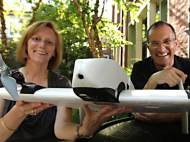
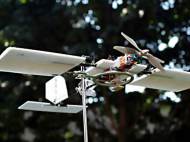
Birds routinely land on small surfaces, using wing morphing and flapping techniques. The UC San Diego engineers, led by mechanical and aerospace engineering professor Tom Bewley and graduate student Kim Wright, analyzed slow motion videos of birds landing to generate a working hypotheses for how biomimicry of wing morphing and flapping can be used for ... »

Instead being treated as useless mistakes, failed demonstrations can provide great insights into better learning, claim scientists from EPFL’s Learning Algorithms and Systems Laboratory (LASA). Their unusual point of view has led to the development of novel algorithms which enable machines to learn more rapidly and outperform humans by starting from failed or inaccurate demonstrations. ... »

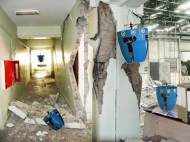
Advanced autonomous robots are being developed by a team from the Georgia Institute of Technology, the University of Pennsylvania and the California Institute of Technology/Jet Propulsion Laboratory (JPL). The program vision is for collaborative teams of tiny robots that could roll, hop, crawl or fly just about anywhere, carrying sensors that detect and send back ... »
By Dag G.
One Comment14 May 2011

Prompting “Hello World” is among the first lessons of programming, but such simple programs aren’t able to catch the attention of young generations who grow surrounded by much more advanced and entertaining interfaces. A product of Carnegie Mellon University Robotics Institute – Finch was designed specifically to make introductory computer science classes an engaging experience ... »