By Damir B.
3 Comments26 August 2011

Researchers from the University of Leeds have discovered a new way to treat the first signs of tooth decay. They developed a peptide-based fluid that is literally painted onto the tooth’s surface in order to reverse the damage of acid attack and re-builds teeth as new. The peptide technology is based on knowledge of how ... »
By Damir B.
23 August 2011

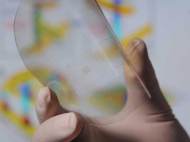
A group of researchers at the University of Colorado Boulder (CU-Boulder) discovered that the extreme flexibility of graphene allows it to conform to the shape of the smoothest surfaces. Its powerful adhesion qualities are expected to help guide the development of graphene manufacturing and of graphene-based mechanical devices such as resonators and gas separation membranes. ... »
By Dag G.
2 Comments19 August 2011

Researchers from Singapore’s Agency for Science, Technology and Research (A*STAR) Institute of Materials Research and Engineering (IMRE) have created a new polymer that can be used in both new age plastic electronics as well as plastic solar cells. The new polymer enables thinner and lighter electronic components and organic solar cells which can be produced ... »
By Damir B.
15 August 2011

Excitons, which are created by light, play a central role in the plastic solar cells energy harvesting. Researchers from Lehigh University have developed an imaging technique that enables direct observation of light-emitting excitons as they diffuse in rubrene – a new generation of single-crystal organic semiconductors that is being explored for its extraordinary electronic properties. ... »
By Damir B.
13 August 2011

A multi-disciplinary team of researchers, led by researchers from the University of Illinois, came up with epidermal electronic system (EES) – a device platform based on a thin skin-like patch that mounts directly onto the skin with ease and flexibility of a temporary tattoo sticker. The technology could be used in electronic components for sensing, ... »
By Damir B.
One Comment11 August 2011

A team of researchers, led by researchers from the Lawrence Berkeley National Laboratory (Berkeley Lab), hopes to become the first in the world to produce electricity from the CO2 heated by energy under the surface of the Earth. The system could also be used to permanently store some of the CO2 underground, thus reducing its ... »
By Damir B.
9 August 2011

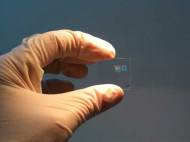
MIT researchers have combined a simple physical interface with computer-vision algorithms to create GelSight – a portable imaging system that can achieve resolutions previously possible only with large and expensive lab equipment. The device could provide manufacturers with a way to inspect products too large to fit under a microscope and it shows potential for ... »