
Conceptual lamp and why we don’t write about concepts
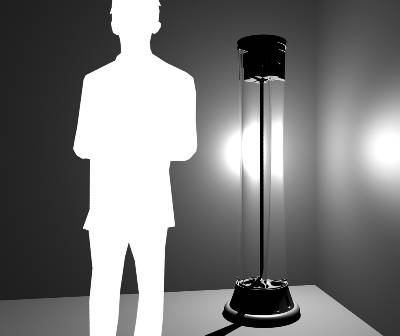 We received a few suggestions on our Twitter account regarding a few conceptual buildings and gadgets. In this article we’re going to make clear why we’re not writing articles related to concepts that aren’t realized at least to some degree. The LED lamp, named Gravia, has won second place in the Greener Gadgets Design Competition as part of the Greener Gadgets Conference in New York City in 2008. Concept illustrations of Gravia depict an acrylic column that glows when activated. The electricity is generated by the slow fall of a mass that spins a rotor. The resulting energy powers 10 high-output LEDs that fire into the acrylic lens, creating a diffuse light. The operation is silent and the housing is elegant and cord free – completely independent of electrical infrastructure.
The promised light output was 600-800 lumens – roughly equal to a 40W incandescent bulb. Each drop of the gravity mechanism runs the light over a period of four hours. To “turn on” the lamp, the user moves weights from the bottom to the top of the lamp. An hour-glass like mechanism is turned over and the weights are placed in the mass sled near the top of the lamp. The sled begins to gently glide back down and, within a few seconds, the LEDs come on and light the lamp, Moulton said. “It’s more complicated than flipping a switch but can be an acceptable, even enjoyable routine, like winding a beautiful clock or making good coffee,” he said.
The acrylic lens should be altered by time in an attractive fashion, Moulton said. “The LEDs produce a slightly unnatural blue-ish light. As the acrylic ages, it becomes slightly yellowed and crazed through exposure to ultraviolet light,” he said. “The yellowing and crazing will tend to mitigate the unnatural blue hue of the LED light. Thus, Gravia will produce a more natural color of light with age.”
He predicted that the acrylic will begin to yellow within 10 to 15 years when Gravia is used in a home’s interior room. And that concept and design were beautiful if there weren’t a few drawbacks as… physics that wouldn’t allow the actual realization of the concept with the usage of current technology available.
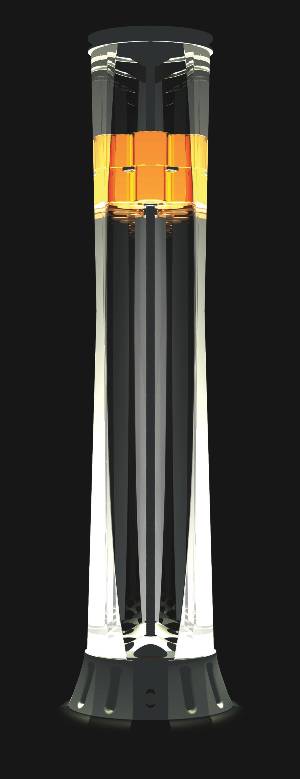
The concept promiced: 600 lumens for 4 hours by harnessing the energy in a 50 pound weight lifted about 1.5 meters. The most efficient LEDs on the market put out about 135 lumens per watt. So they need at least on the order of 4 watts for 4 hours. That’s 4 * 4 * 3600 = 57600 joules.
E = mgh
Solving for mass,
m = E/(gh)
m = 57600 / (9.8 * 1.5) = 3918 kilograms
So you need to lift a 4000 kilogram mass 1.5 meters to run this for 4 hours, and that’s assuming a 100% efficient generator. Either that or you need to lift the 50 pound mass 57600/(22.7*9.8) = 259 meters. Either way, you need something on the order of 175 times more energy than they have available.
Going at it a different way: 50lb is 22.7kg. At 9.8m/s^2 it exerts 222 newtons of force. A watt is a newton-meter, so this weight must descend 4/222=.018m/s to produce 4 watts. There are 14400 seconds in four hours. 14400*.018=259 meters.
Although a nice idea it’s phisicaly imposible to realize it with current technology. A nice modification to the lamp would be providing less light and dimming materials at the bottom of the lamp so it could be used as a sleeping light.


damn those physics!
imho there are some concepts worth writing about.