
Emotiv EPOC – an accessible mind-cotrolled headgear
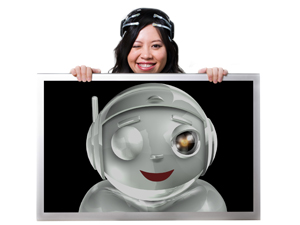 At a company called Emotiv a few dozen scientists have developed the gear and software that quite literally read the mind and it’s going to hit the mass market in this year. For it’s relatively low price (comparing to similar yet more complicated and robust), you will be able to vaporize onscreen enemies with an angry thought, have your online characters smile when you smile, and see video games react to your level of excitement very soon.
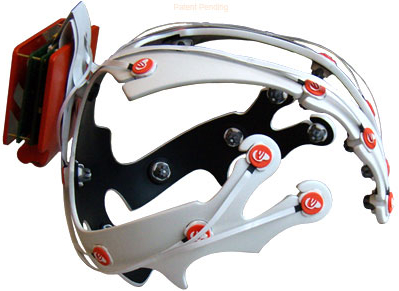
This thought-conversion technology is composed of some extremely sophisticated software and a piece of headgear that looks like a cross between a telephone headset and a skeletal bike helmet. Embedded in the headset are 16 electrodes that press lightly the scalp, monitoring the electrical signals of the brain. The headset passes the signals to the software, which extracts patterns that can be used to control anything that’s run by electronics.
After enabling us to control video games with our minds, Emotiv intends to let us control most everything else we do on our computers and, after that, what’s around our homes. In 10 years or so, according to the company’s co-founder Tan Le, we will all go around in a world that will respond to our mental commands.
Ultimately, Emotiv decided to treat emotional signal processing as a sort of math problem that could be solved with clever software. Emotiv opened an office in Sydney and staffed it with mathematicians, digital signal processing experts, and artificial intelligence whizzes. To help keep R&D costs manageable, Emotiv leaned heavily on graduate students willing to work for free in exchange for having some exciting, cutting-edge research on their resume.
The result was a software program that broke brain waves down into 90,000 components. It was so complex that running a single 10-second brain-wave reading through the program took six computers two days. And sometimes the two-day crunching session would be for naught: The brain-wave readings were so faint that just the electrical activity generated in an eye blink was enough to swamp them. To work well, the software had to learn to filter out the noise.
Emotiv is working with a wheelchair company to develop a thought-controllable device for those who can’t move their body. But that’s a sideline. The decision to shoot for a mass market immediately led to another: The one market that seemed ripe for a large-scale invasion of innovative interface technology was the video-game industry. “Better and better graphics had reached a point of diminishing returns, while there had been almost no innovation in controllers,” Le says. “And gamers tend to be early adopters, making them a good incubator for a new technology.”
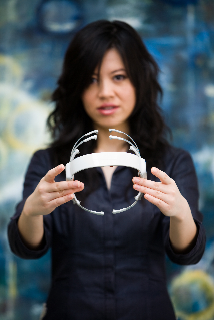
With a market in mind, Emotiv could now pin down the details of its device. Gamers weren’t going to wear a gooey bathing cap, so the team came up with a rigid, relatively unobtrusive, even cool-looking headset able to get an accurate brain-wave reading with 16 gel-free sensors instead of the 128 sticky ones in a standard EEG cap. The headset was augmented with a tiny gyroscope to track head motions and a wireless transmitter to free the wearer of wires. More important, the software’s brain-wave-interpreting capabilities were improving by leaps and bounds. The software would eventually be able to differentiate among 30 of what the company characterizes as mental states, roughly divided into three categories – emotions, facial expressions, and actions. All three types of mental states would be critical: Actions would allow controlling what a character does, facial expressions would convey feelings and intentions to fellow online players, and emotions would allow a game to respond to how a player was feeling. A plot could change when you were bored, a virtual character could appear more often if you found him engaging or threatening, music or lighting could shift to complement your mood.
To make the device easier and more fun to use, Emotiv’s team worked furiously with a small video-game-development company called Demiurge Studios in Cambridge, Massachusetts, to embed the technology in a game-like context. Instead of a boring training session, an Asian sensei walks you through an exotic introduction to your new powers. He gets you to grimace at annoying flying creatures to make them flee, to lift heavy objects, and more. This acclimation process gives the software a chance to record your brain waves and trains you to use them consistently before it throws a series of increasingly difficult challenges at you, such as reconstructing simply via thought a fallen bridge needed for a mystical journey while a fiery sky changes hue in response to your emotional state. Another mini game teaches you to hurl thunderbolts.
Meanwhile, competitors were massing. CyberLearning Technology in San Marcos and OCZ Technology in Sunnyvale, for example, have both developed neural headsets. Hitachi in Japan has poured money into potential mind-reading products, and dozens of universities have made efforts to develop better, cheaper thought processors, any of which could lead to spinoffs. There’s even an ambitious project funded by the U.S. military, which hopes to have patrolling soldiers communicating by thought within two decades.
But most notably, there’s NeuroSky in San Jose, which has developed a single-electrode game-control headband. NeuroSky’s device can detect only two mental states – attention and meditation but it costs significantly less than the competition.
A company called EmSense is making inroads into the corporate market with a headset that measures the reactions of consumers to games, ads, and other entertainment and marketing creations. EmSense hopes to provide its clients with a detailed, high-tech analysis of what flies with what types of consumers. Coca-Cola used EmSense last year to help fine-tune its Super Bowl advertising decisions. That’s a business Emotiv wants to be in on as it moves beyond gaming, and no wonder.
Meanwhile, the team continues to think beyond games. The headset already can be used in word processing and spreadsheet programs or by replacing the computer mouse – the cursor simply follows your gaze, and you can think your way into triggering the equivalent of a left or right mouse click.








Hi. Based on reviews and pros/conc of all the discssued different solutions, I invested in this NeuroSky MindSet and use it with Win7. I also have had some bad experience with the connection, but it seems like it was always due to the Bluetooth setup/paring. When it is properly connected the wawes are transmitted very well after approx half a minute, and the sensors are not as depending on contact etc as I had expected with only one main forehead sensor and 3 ear sensors.The connection problem. Please note that I use the standard Laptop Bluetooth (BT) connection, and not the dongle. I fear that two BT connections from the same PC with Win7 can only make my issues worse. What puzzled me first a few times was, that even the Visualizer informs a connection but no wave signal, it is not the sensor signals which is blocked by missing brainwave contact, but actually the Bluetooth data which is not transferred. Because, when checking the Bluetooth connection within the properties for the specific device in Win7, it informs the date and time for last connection, and NOT Currently connected (which it does when it works). In my case I expected the reason for the improper setup was that I had also paired the MindSet with my mobile phone at some time, and maybe the pairing with the PC was damaged, but maybe this is not the full story, I don’t know. But after removal of the Bluetooth MindSet device (setup) in the Win7, rebooting of the PC, and a new pairing of MindSet and laptop, it seems to connect just fine every time.But on top of this, when starting up data transfer it seems like it often requires more than 10 seconds to settle and show that there are data available, so if you are impatient and are moving the sensor it seems like it starts all over this settling, and the experience is that it never connects .I have subjective experience that the settling is improved if I moist the sensors a little.
So if I moist the sensors, place the forehead sensor relatively close to my eyebrow, and be a little patient with the data settling, it seems to be very consistent and stable with Win7.So the first hurdle is to get the BT paired well which is possible with direct Bluetooth in Win7 from a standard laptop if not trying to use the headset with other devices. The sound is so bad anyway, which is also noted previously. And then learn how to handle the sensors (not moving them constantly to try to get connection). Maybe moist the forehead sensor and place it just above the eyebrow. If this basic BT setup is in place, it seems like even a 12 year old boy can start it up and use it after a little introduction of the handling.Just a note rgd. wired headset. I believe that the reason why the MindSet works so relatively stable regardless of few sensors, is that it is wireless, so all the grounding noise issues are out of the way. I read that noise is the main reason for unstable behavior by other wired sensor-solutions, where you have to touch something or sit very tight. The signals from the sensors are very weak, and these solutions are inherently very sensitive to ground/chassis noise, unless designed 100% balanced with a very high common mode rejection. Especially in PC environments with switching power supplies and clock circuitry with fast rise times, making the ground jumping up and down many places in the signal path.
So NeuroSky, if you read this, keep the wireless solution, but make the BT pairing / connection easier to use and more stable. It should also be easy to improve the sound quality .Actually I wish the MindSet unit did not have the headset capability, but only the sensors, so I could use it without covering both ears, as I always turn down the sound anyway (terrible sound quality and I prefer to meditate without music). Also, the ear-cups makes my ears warm, and limit my meditation time, because they my attention are turned towards them instead. And it would last longer on the battery as the power for sound circuitry etc are eliminated.Has anyone seen an application where I can log the Meditation level e.g. every half second, and get a graph of a meditation session over time (like one hour)? Or is this easy to develop with the SDK?
Regards,
Sven