
MIT’s Flyfire – swarms of micro helicopters form 3D images
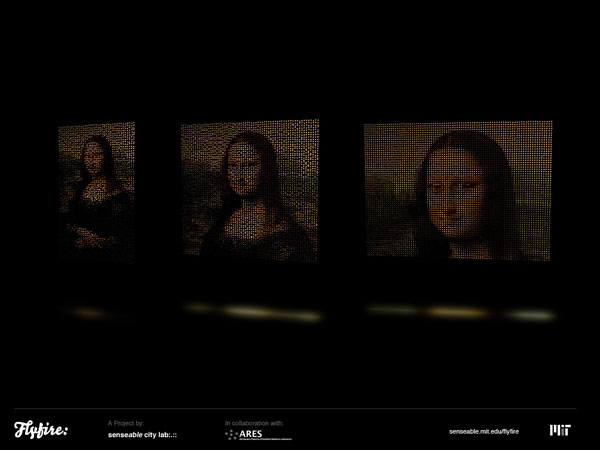 Flyfire, a project initiated by the SENSEable City Laboratory (the same folks that came up with AIDA) in collaboration with ARES Lab (Aerospace Robotics and Embedded Systems Laboratory) aims to transform any ordinary space into a highly immersive and interactive display environment. Imagine that pixels could fly out of your computer screen and create an immersive, luminous cloud capable of displaying digital information in three-dimensional space.
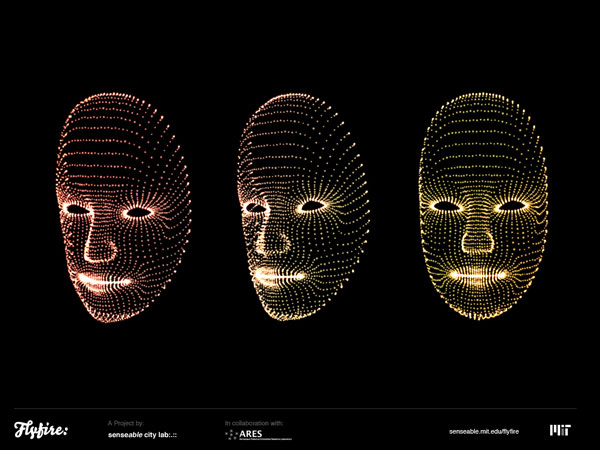
Flyfire uses a large number of remotely controlled, self-organizing “micro helicopters”. Each helicopter contains small LEDs and acts as a smart pixel. Through digitally controlled movements, the helicopters perform elaborate and synchronized choreographies, in order to form an elastic display surface in three-dimensional space.
“It’s like when Winnie the Pooh hits a beehive: a swarm of bees comes out and chases him while changing its configuration to resemble a beast”, said E Roon Kang, a research fellow at the SENSEable City Lab who is leading the project. “In Flyfire, each bee is essentially a pixel that emits colored light and reconfigures itself into different forms.”
With the self-stabilizing and precise controlling technology from the ARES Lab, the motion of the pixels is adaptable in real time. The Flyfire canvas can transform itself from one shape to another or morph a two-dimensional photographic image into an articulated shape. The pixels are physically engaged in transitioning images from one state to another, which allows the Flyfire canvas to demonstrate a spatially animated viewing experience.
“Today we are able to simultaneously control a handful of micro helicopters, but with Flyfire we are aiming to scale up and reach very large numbers,” said Emilio Frazzoli, head of the ARES Lab.
The whole project is made possible by recent advances in battery technology and wireless control. It aims to be a step towards ‘smart dust’ – the idea that computing is becoming increasingly smaller, addressable, pervasive – and persuasive.
Flyfire is conceived as a public space installation, in which the pixels recharge every few minutes and then perform in space. “In general, there are two ways to increase the resolution of a display,” said Carlo Ratti, director of the SENSEable City Lab. “One is to use smaller pixels. The other one is to look at it from farther away. Flyfire adopts the second approach to create a unique visual experience in large public spaces.”
“Flyfire opens up exciting possibilities: as on a conventional screen, pixels can change color, but now they can also move, creating a transient trace of light in three-dimensional space,” said team member Carnaven Chiu. “Unlike traditional displays that can only be seen from the front, Flyfire becomes a three dimensional immersive display that can be experienced from all directions.”

Leave your response!