Home » insect

Articles tagged with: ‘insect‘

Robotics»

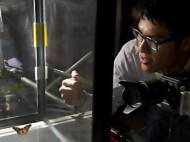
Analyzing butterfly flight for better MAV maneuverability

tiras-butterfly

Although micro aerial vehicles (MAVs) could be very useful in search and rescue, exploration and environmental monitoring missions, due to their small size they still lack maneuverability. Johns Hopkins University (JHU) engineers are using high-speed video cameras to figure out how butterflies manage to fly with amazing grace and agility in order to improve maneuvering ... »

Bionics»

Shrilks – amazing new material inspired by insect cuticle

shrilk

Researchers at the Wyss Institute for Biologically Inspired Engineering at Harvard University have applied biomimicry of insect cuticle – tough but flexible, non-mineral outer coverings that provide protection – to develop a similar material they named Shrilk. The new material is able to mimic the exceptional strength, toughness, and versatility of the extraordinary material, while ... »

Bionics| Robotics»

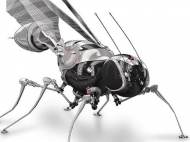
Researchers observe flying insects to create smaller flying machines

robot-insect-iunewind

A group of researchers from the University of Oxford is developing small aerial vehicles with flapping wings inspired by those found on insects. The researchers envision that their insect-size vehicles will be suitable for many different purposes ranging from helping in emergency situations considered too dangerous for people to enter, to covert military surveillance missions. ... »

Bionics»

Silk moth’s antenna inspires development of better nanospores

moth-biomimicry-nanopore

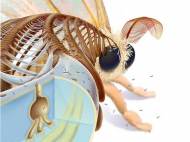
By mimicking the structure of the silk moth’s antenna, the research of University of Michigan researchers has led to development of better nanopores (essentially holes drilled in a silicon chip). Nanopores can be used to study single molecules or proteins, and the tiny tunnel-shaped tool could lead to advances in understanding neurodegenerative diseases such as ... »

Bionics»

Insect hearing biomimicry inspires new approach to small antennas

ormia-ochracea

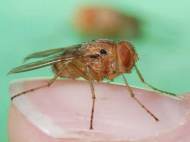
Ormia ochracea is a small parasitic fly best known for its strong sense of directional hearing. A female fly tracks a male cricket by its chirps and then deposits her eggs on the unfortunate host. The larvae subsequently eat the cricket. Though it doesn’t work out well for male crickets, such acute hearing in a ... »

Bionics| Robotics| Tech»

Biomimicry of honeybee eye could improve robotic vision

honey-bee

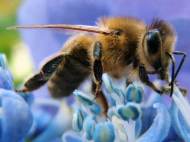
The capabilities and behavior of bees have inspired scientists in various fields as swarm movement and cooperation. Neurobiologists from Bielefeld University, Germany, have been researching the computational mechanisms that allow the nervous system to extract behaviorally relevant information from the retinal input and to use this information in behavioral control. In their previous research, the ... »

Robotics»

Thermally actuated microrobot with omnidirectional walking

thermal-powered-centipede-like-microrobot-1

The past few years have given rise to a growing number of microrobots, miniaturized mobile machines designed to perform specific tasks. Researchers at the University of Washington and Stanford University have developed an insect-like robot with hundreds of tiny legs. The robot is able to carry loads more than seven times of its own weight ... »