
Dark Flash – taking photographs without annoying flashes
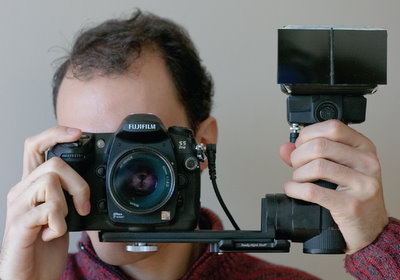 A camera that takes photos with an invisible flash of infrared and ultraviolet light points to a smarter way to take photos in the dark. Dilip Krishnan and Rob Fergus at New York University created the camera in an attempt to deal with problems which regular flashes have. To make their “dark flash” camera, they modified a flashbulb to emit light over a wider range of frequencies and filter out visible light. The pair also had to remove the filters that usually prevent a camera’s silicon image sensor detecting IR and UV rays.
Camera flashes produce intrusive bursts of light that disturb or dazzle. Their prototype camera and flash use infra-red and ultra-violet light mostly outside the visible range to capture pictures in low-light conditions. This “dark” flash is at least two orders of magnitude dimmer than conventional flashes for a comparable exposure. Built on ideas from flash/no-flash photography, it captures a pair of images, one using the dark flash, other using the dim ambient illumination alone.
Afterwards, the correlations between images recorded at different wavelengths in order to denoise the ambient image and restore fine details to give a high quality result, even in very weak illumination. The processing techniques can also be used to denoise images captured with conventional cameras.
Despite the impressive results, a few problems remain. Some materials or objects absorb both UV and IR light and so don’t appear in the dark flash image or the reconstruction. For instance, the subject’s freckles are visible in the long-exposure image, but not in the computer-reconstructed image.
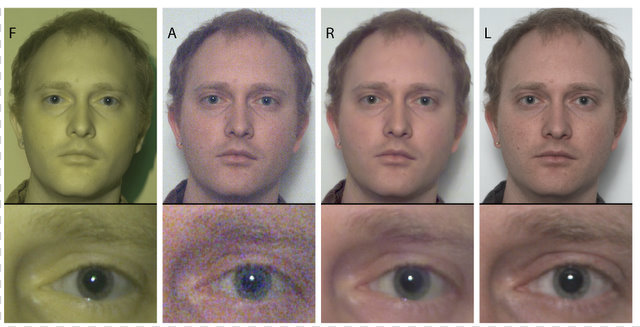
We have demonstrated a camera and flash system that can take pictures in low light conditions using a flash that is far less noticeable and disruptive than a conventional one. The system uses standard hardware for the most part, combined with novel image processing techniques. The spectral constraints are a powerful way of combining the images, yielding good quality results in low light conditions. In addition, we have shown that the hardware and software techniques introduced in this paper can be used in a number of other applications.
The hardware is a prototype and the developers claim that it can be improved in a number of ways. An obvious limitation is the need to take two images of the scene. This precludes the capture of fast moving scenes and adds to the overall complexity of the system. However, by modifying the Bayer pattern on the sensor to include UV-only and IR-only pixels (for a total of 5 channels), they would be able to implement the dark flash concept using a single image.
Additionally, their large flash unit could be replaced with compact UV and IR LEDs, thus giving more controllable pulse duration and more precise spectral emission, with a potential further reducing of the visibility of the flash. This would also permit the dark flash concept to be implemented in small platforms such as cell-phones, where a flash is often needed due to poor low-light performance on account of the small sensor size.
Krishnan and Fergus will present their work at the Siggraph conference in New Orleans in August.



Leave your response!