
Green architecture – HPA Energy Lab in Hawaii
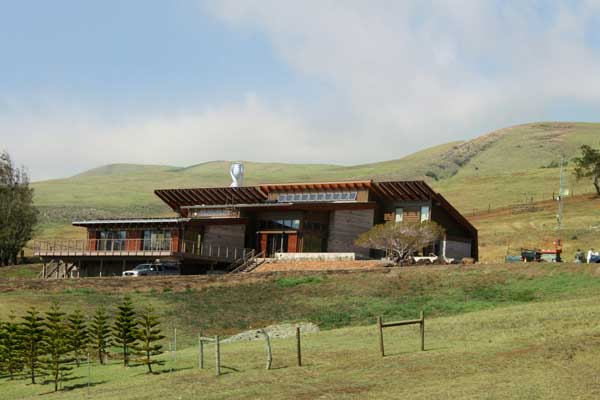 Hawaii is subject to the high energy costs, partially because of its dependency on non-renewable energy sources. On the other hand, the very isolation from the mainland can also be beneficial for renewable energy sources as wind and solar harnessing, tidal and geothermal energy. The Hawaii Preparatory Academy Energy Lab concept was developed at a Go Green charrette (workshop) in May 2007, when a group of students, faculty, administrators, and parents met for an intensive day-long session to create a vision for a sustainable campus.
Architect David Croteau of Flansburgh Architects in Boston, along with his team of consultants, designed the 568 square meters Energy Lab with input from the donors, faculty staff, students, and others, including project manager Ken Melrose. Croteau envisions the Energy Lab as “a place where students work in teams to research, design, and develop new and existing renewable energy technologies. We are hopeful that students will take full advantage of the lab’s unique site to test these technologies.”
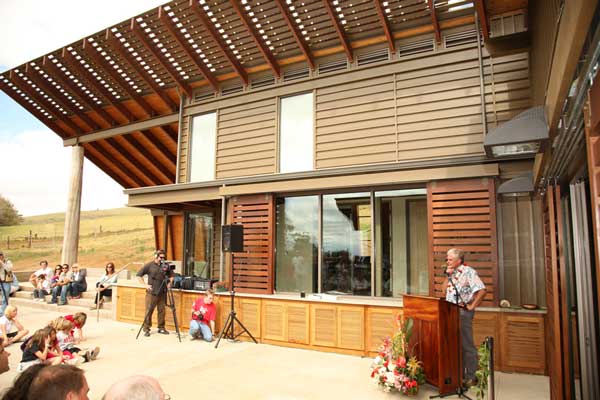
The two-story building (which also has a basement for storage) features open classroom areas and outdoor courtyards and decks, protected from the wind, which will encourage collaborative learning. The Lab consists of three “zones” that mimic the creative process students experience when working on projects, from brainstorming to design to physical construction.
The long, mauka building features individual project rooms equipped with computers and SmartBoards that also can be used as monitoring labs and a video conference room for 12-15 people. The central structure is a collaborative, carpeted flexible open space with a central set of screens configured in a triangular shape so no matter where a student is in the room, the screens are visible.
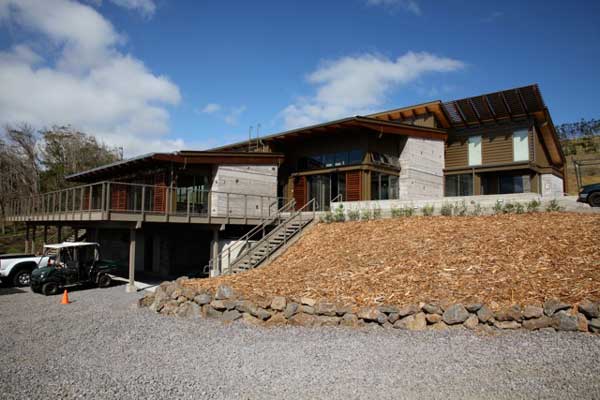
The front section is a workshop where all building and testing will take place. Tools and materials also will be stored here. This design supports an educational model for the 21st century that Wiecking describes as “teacher moving from sage on a stage to more of a facilitator or resource; it’s a learning style where students work together in teams instead of being in a classroom with the teacher up front.”
Wind turbines and an array of roof-mounted photovoltaic panels will strive to produce 100 percent on-site renewable energy for the lab on a net annual basis. All wood is Forest Stewardship Council (FSC) Certified or from salvaged sources. Every closed area has operable windows and the building is almost entirely naturally ventilated. An innovative radiant cooling system, which uses colder nighttime air to chill water, is used to condition warm spaces during the day.
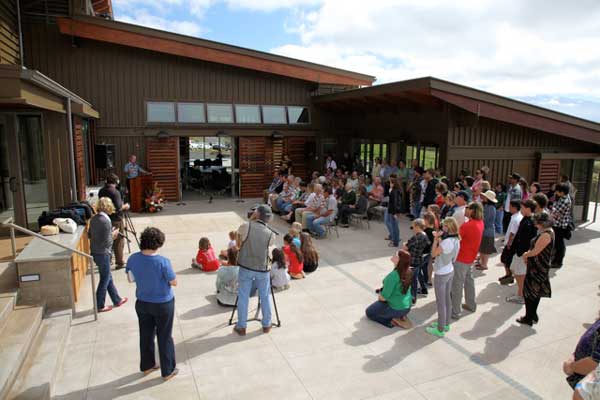
“The building’s energy use and energy generation will be monitored,” says Croteau. “Sensors will monitor and control artificial lighting and natural air flow. The building’s performance will be shown on monitors at the lab and around campus.”
Energy use in all campus buildings will be monitored from the Energy Lab, including a “test house,” one of the faculty cottages. “We’ll do the research and find out the best way to do things, model best practices with the kids, and share what we learn with the community,” says Wiecking, who sees the outreach component extending beyond local communities and schools to hosting national and international summer conferences, which is a natural extension of the Lab’s mission of education, monitoring, and outreach.
According to Buro Happold, an international engineering firm that has developed innovative building technologies for some of the world’s most renowned architects, HPA’s Energy Lab could be the first K-12 school facility in the world to meet the Living Building Challenge, a criteria that exceeds LEED Platinum certification, which the school also is pursuing (we already wrote about one building matching that criteria).
Share:

-
-
-
-
-
-
Glad to find an interest in sustainable design in HI. As a tourist on the Big Island, I have been quite disappointed with the apparent absence of such design. Maybe it is integrated into conventional appearing structures.
I was also hoping to see a distinct design aesthetic. Most of what I see mimics mainland construction – certainly nothing to mimic!
Jerry Parker
Olympia WA
author
The laboratory received the highest level of certification under the Living Building Challenge.
The award is “Living” status and the Energy Laboratory is the third building in the world to achieve this honor.