
Kyosemi Sphelar – spherical micro solar cell
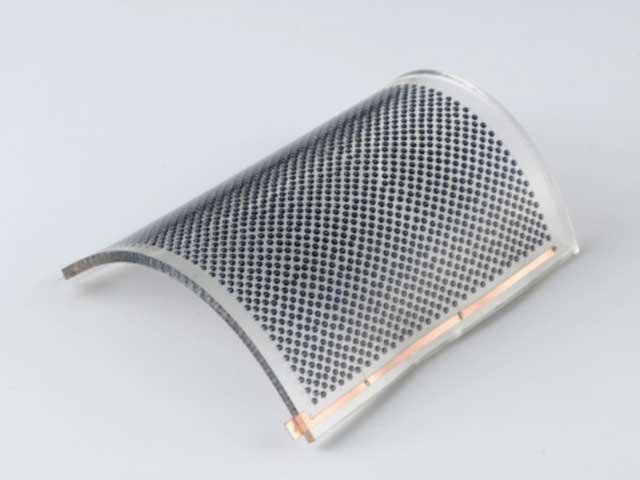 Developed by Kyosemi Corporation, Sphelar solar cell takes on a spherical shape, which makes it capable of power generation with greater efficiency and flexible applications. These spherical cells were shown at the recent PV Expo 2010 in Tokyo, where they demonstrated how the windows in buildings might be used to collect solar power in the not-so-distant future.
Sphelar cells are solidified silicon drops measuring 1.8 mm in diameter and are highly transparent. They can be embedded in glass to create a transparent solar cell window, capable of absorbing light from any direction or angle. Because both sides of the glass can collect light, this approach should be able to perform more efficient energy harvesting.
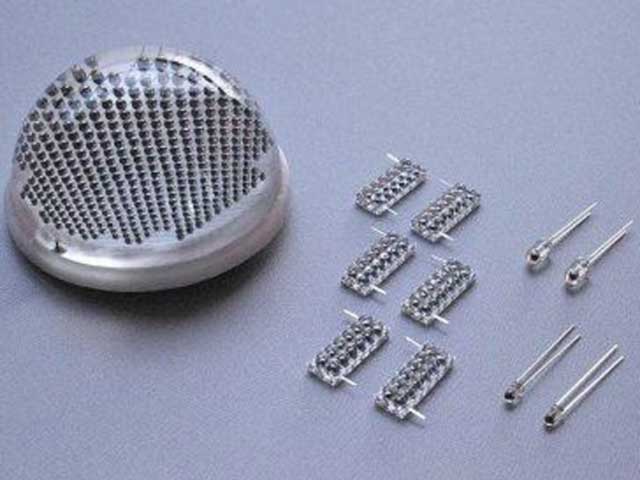
They can be connected either in parallel or in series. This enables diverse spherical products to be created, such as dome-shaped solar cells and “flexible” solar cells aligned on soft film substrates. Sphelar is perfect for situations where the installation of a flat solar cell would block the field of view. It is also possible to create “power-generating window glass” while maintaining a certain level of transparency, ranging from 20 to 80%. The cells can also be embedded in flexible surfaces, allowing for them to take on unusual shapes or be bent if necessary.
Conventional flat solar cells are produced by slicing crystalline silicon ingots, generating a large quantity of “Kerf loss” in the production process. In contrast, Sphelar is produced using a unique process where they use microgravity under space-like conditions to make them. They drop molten silicone from the height of 14 meters (almost 40 feet). The surface tension causes droplets to form spherical shape and (under the mentioned microgravity conditions) the droplets naturally crystallize after 1.5 seconds. The mentioned process makes several thousand silicone single crystal spheres every second.
Since there is hardly any waste of raw materials at all, this results in a dramatic reduction of costs, and helps ensure the efficient use of silicon, a finite resource. Sphelar is a more environmentally-friendly product, not only in terms of performance but also during the production phase.




hi im peter and i would like to talk to someone about your micro solar cells.
are these available for purchase?
i hope to hear an email from you thanks..
author
I hope you found the link to their website in our article in meantime.
I have visited their website and written to them with no answer. Can anyone tell me if these are available for purchase yet?
author
I’m not sure have you used Sphelar Power website which got online after this article was written. They use it to promote twists on their technology, as well as some Sphelar Design Products where they use Spheral cells to power lanterns and garden lighting.
Although prices aren’t available to the public without inquiry, I can tell you the retail price of the Sphelar Lantern which costs around $490 at the moment.
Good luck!