
More affordable LEDs manufactured on silicon
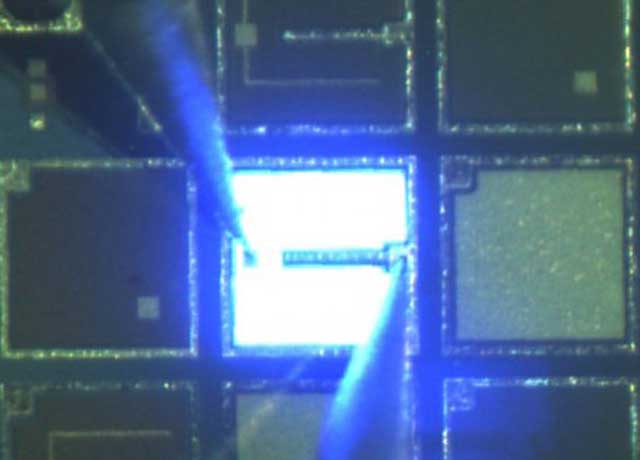 Light-emitting diodes, or LEDs, are envisioned as replacement for incandescent light bulbs, which are being phased out by the EU. Researchers at the University of Cambridge have developed a new technique that could lead to production of more affordable LED light bulbs. Aside making them more affordable, the researchers claim their discovery could have a dramatic impact on carbon emissions.
Led by Professor Sir Colin Humphreys at the Department of Materials Science and Metallurgy, University of Cambridge, the team has developed an effective method to grow growing gallium nitride crystals on silicon instead on sapphire. During the development, the research was supported with funding from the Engineering and Physical Sciences Research Council (EPSRC).
“We’ve got higher efficiency for growing gallium nitride on silicon than anyone else we know. Potentially this is a deal that puts Britain right at the forefront of LED research”, said Humphreys. “LED light bulbs currently cost as much as £40, but we expect to be able to reduce that cost by a factor of five by growing on silicon. Mass manufacturing may reduce the cost further. Eventually I think that we will see LED lighting being fitted throughout the world.”
His team managed to overcome the problems with trying to grown gallium nitride on silicon by addressing difficulties with thermal expansion under the growth temperature. At high temperatures, Gallium Nitride expands at a very different rate to silicon and when the two substances cool down, the material tends to crack. By introducing layers to the process that put the gallium nitride in a state of compression before it heats up, the material relaxes during cool down and it allows crack-free LED structures.
Unlike the 2-inch sapphire wafers used thus fur, the new process allows growth of LEDs on 6-inch silicon wafers which currently cost around £20 ($31) which allows increase in production of up to 10 times.
The method will be commercialized by a new arm of Plessey, called Plessey Lighting, which will initially make LEDs on silicon for external manufacturers, but in time hopes to develop its own light bulbs in-house. Plessey was chosen because it already has the equipment to manufacture silicon wafers of this size, and their broader work in electronics could lead to development of “smart lighting” from LED light bulbs as well.



Great improvement in the manufacture oif LEDs.
Dr.A.Jagadeesh Nellore(AP),India
E-mail: anumakonda.jagadeesh@gmail.com
LED LIGHTING CAN ALSO WORK AS ANTI DEPRESSANTS AND LEAD TO LESSER EYE PROBLEMS,
PEOPLE TEND TO EAT LESS WITH LED LIGHTING.
PEOPLE TEND TO TALK MORE FREQUENTLY WITH EACH OTHER WHEN SURROUNDED BY LED LIGHTS.
ITS THE NEXT THING TO SUNLIGHT!
CHECK IT OUT AND EMAIL ME on vincmic@gmail.com attention John
Very nice site!
I have seen an article for 2009 on the ultrathin led , I am having a hard finding if this product is in production , or ant tech specs on it . If there is any to get some info , can someone please drop me a line , thanks for your time , Neil .