
Smaller and more efficient nuclear batteries
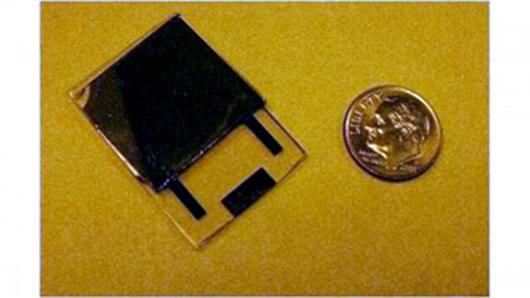 an alternative for them, other scientists are finding ways to make them smaller and more powerful. This is especially important in micro and nano scale where problems can arise when these batteries are much larger and heavier than the devices themselves. University of Missouri researchers are developing a nuclear energy source that is smaller, lighter and more efficient.
“To provide enough power, we need certain methods with high energy density,” said Jae Kwon, assistant professor of electrical and computer engineering at MU. “The radioisotope battery can provide power density that is six orders of magnitude higher than chemical batteries.”
Kwon and his research team have been working on building a small nuclear battery, currently the size and thickness of a penny, intended to power various micro/nanoelectromechanical systems (M/NEMS). Although nuclear batteries can pose concerns, Kwon said they are safe.
“People hear the word ‘nuclear’ and think of something very dangerous,” he said. “However, nuclear power sources have already been safely powering a variety of devices, such as pace-makers, space satellites and underwater systems.”
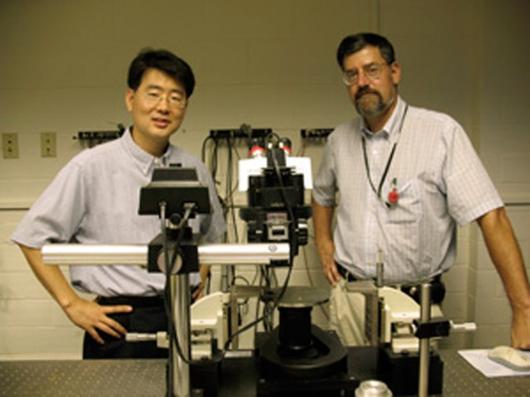
His innovation is not only in the battery’s size, but also in its semiconductor. Kwon’s battery uses a liquid semiconductor rather than a solid semiconductor.
“The critical part of using a radioactive battery is that when you harvest the energy, part of the radiation energy can damage the lattice structure of the solid semiconductor,” Kwon said. “By using a liquid semiconductor, we believe we can minimize that problem.”
Kwon has been collaborating with J. David Robertson, chemistry professor and associate director of the MU Research Reactor, and is working to build and test the battery at the facility. In the future, they hope to increase the battery’s power, shrink its size and try with various other materials. Kwon said that the battery could be thinner than the thickness of human hair. They’ve also applied for a provisional patent.







Leave your response!