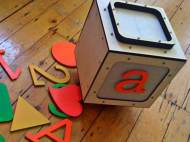
In order to counter the multimedia brought by TV shows and video games which leave kids stationary, the researchers at the MIT Media Laboratory are developing a system called Playtime Computing. Aside the projectors, the prototype of the Playtime Computing system consists of a cube-shaped, remote-controlled robot, called the Alphabot, with infrared emitters at its…
»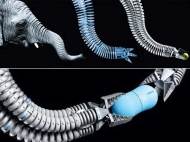
The ability of elephant’s trunk to be flexible, transmit large forces, and serve as a precise gripping tool, has inspired researchers to come up with the Bionic Handling Assistant. It was developed by Festo in cooperation with the Fraunhofer Institute for Manufacturing Engineering and Automation (IPA) and within the framework of the Bionic Learning Network…
»
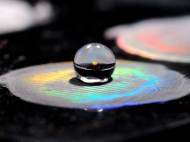
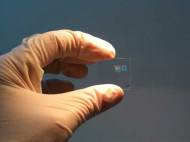
A discovery by University of Cincinnati researchers could revolutionize display technology with e-paper that’s fast enough for video yet cheap enough to be disposable. In their research, Andrew Steckl and UC doctoral student Duk Young Kim demonstrated that paper could be used as a flexible host material for an electrowetting (EW) device. EW involves applying…
»
Although we tend not to write about prefabricated homes, here is an article about a house that was recently exhibited in Millennium Park, Chicago. Inspired by the glass pavilion-style Farnsworth House designed by Bauhaus architect Mies Van Der Rohe, the folks from Virginia Tech came up with LUMENHAUS – a prefabricated house which features a…
»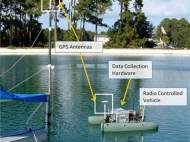
With the increased use of underwater robotics, underwater navigation becomes more and more important. A research team from Naval Research Laboratory, the University of Washington, and Naval Surface Warfare Center has developed and tested an underwater navigation system that uses a spiral shaped acoustic wave to determine aspect. The single stationary beacon can provide a…
»
Imagine a computer equipped with shock-proof memory that’s 100,000 times faster and consumes less power than current hard disks. Professor Mathias Kläui from EPFL and PSI is working on a new kind of “Racetrack” memory, a high-volume, ultra-rapid non-volatile read-write magnetic memory that was invented at IBM and may soon make mentioned features possible. Although…
»
A bacteria that can knit together cracks in concrete structures by producing a special ‘glue’ has been developed by a team of students at Newcastle University. The genetically-modified microbe has been programmed to swim down fine cracks in the concrete. Once at the bottom, BacillaFilla produces a mixture of calcium carbonate and a bacterial glue…
»
In a first step toward achieving industrial-scale green production, scientists from the U.S. Department of Energy’s (DOE) Brookhaven National Laboratory and collaborators at Dow AgroSciences reported engineering a plant that produces industrially relevant levels of compounds that could potentially be used to make plastics. The research is reported online in Plant Physiology, and will appear…
»