Located on Bainbridge Island, the Ellis Residence is the first LEED Platinum certified single-family home in Washington State outside of Seattle. It was designed by Coates Design Architects for owners Ed and Joanne Ellis. The Ellis Residence is a fascinating blend of style and sustainability with a warm feel in its interior which is achieved…
»
Researchers at the University of Arizona Controlled Environment Agriculture Center (CEAC) are demonstrating that plants from Earth could be grown hydroponically (without soil) on the moon or Mars, setting the table for astronauts who would find potatoes, peanuts, tomatoes, peppers and other vegetables awaiting their arrival. The technology shows a great potential for application on…
»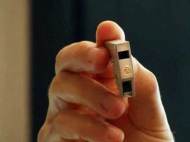
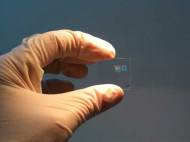
Micro electro-mechanical systems (MEMS) are becoming more popular as a basis for the next generation of optical materials. Lemoptix, a spin-off of EPFL, working together with the Maher Kayal Laboratory, completed their development of their miniature projector at the beginning of September. Its developers claim it should be on the market by the end of…
»
As we already wrote in our previous articles, scientists around the world are working to develop pressure sensors for artificial skin which could be applied on prosthetic limbs or robots. By sandwiching a precisely molded, highly elastic rubber layer between two parallel electrodes, the team from Stanford University created an electronic sensor that can detect…
»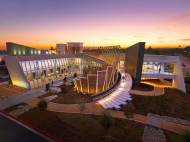
Located in Rancho Cucamonga, California, the Frontier Project displays and utilizes sustainable innovations for Southern California living and working environments. Designed by HMC Architects, the building is a 1,300-square-meter (14,000-square-foot) demonstration of how sustainable design can be economical, efficient, and inviting. The Frontier Project’s goal is to educate resident consumers, commercial builders, and sustainable advocates…
»
A robot deceives an enemy soldier by creating a false trail and hiding so that it will not be caught. While this sounds like a scene from one of the Terminator movies, it’s actually the scenario of an experiment conducted by researchers at the Georgia Institute of Technology as part of what is believed to…
»
Although it’s been years since optical tweezers have been used to move particles, the previous methods weren’t able to move them on distances larger than few millimeters. Researchers at the Australian National University (ANU) made a breakthrough by developing a method which can move objects much further by using laser beams. The researches have managed…
»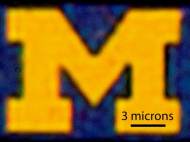
Conventional LCDs, or liquid crystal displays, are inefficient and manufacturing-intensive to produce. Only about 5 percent of their back-light travels through them and reaches our eyes. In a step toward more efficient, smaller and higher-definition display screens, a University of Michigan professor has developed a new type of color filter made of nano-thin sheets of…
»