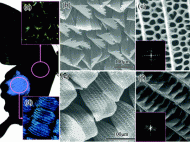
Even though silicon is one of the most abundant elements, the energy required to make silicon from sand is immense. A group of researchers from the Swiss Federal Institute of Technology in Lausanne (EPFL) developed a new nanopatterning technique which boosts the output of the cells, thus enabling manufacture of solar cells that are one…
»
Rechargeable lithium-ion batteries are now the power of choice for a variety of portable consumer electronics. A group of researchers from the University of Leeds has invented a new type of polymer gel that could replace the liquid electrolytes currently used in rechargeable lithium cells. It would also enable production of cheaper lithium batteries without…
»
Researchers from the U.S. Department of Energy (DOE)’s Lawrence Berkeley National Laboratory (Berkeley Lab) have unveiled a semiconductor nanocrystal coating material capable to control the amount of solar heat while remaining transparent. The technology is the first to selectively control the amount of near infrared radiation and it is based on electrochromic materials (which use…
»
IBM partnered with 3M in order to develop adhesives that can be used to package semiconductors into 3D semiconductors. In order to develop these densely stacked silicon “towers”, IBM will draw on their expertise in creating unique semiconductor packaging processes, and 3M will provide their expertise in developing and manufacturing adhesive materials. The joint research…
»
Collaboration between researchers at the Clemson University and the Georgia Institute of Technology resulted with a promising new binder material for lithium-ion battery electrodes. Known as alginate, the material is extracted from common, fast-growing brown algae, and it could boost energy storage, while eliminating the use of toxic compounds now used to manufacture the components….
»
Rice University engineering researchers have made a breakthrough that could allow wireless phone companies to double throughput on their networks without adding a single cell tower. Instead using two frequencies to send and receive data, Rice’s new “full-duplex” technology allows wireless devices like cell phones and electronic tablets perform this communication with cell towers while…
»
The adhesive surface of gecko’s toes has inspired many research groups to try to mimic this ability in an artificial material. Researchers at the A*STAR Institute of Materials Research and Engineering and co-workers at Nanyang Technological University in Singapore claim that they came up with the closest biomimicry yet, and that their synthetic gecko toe…
»
The Warren and Katharine Schlinger Laboratory for Chemistry and Chemical Engineering building is a part of California Institute of Technology (Caltech) and it is expected to receive LEED Gold certification. Along with focus on sustainability and resource conservation, the Schlinger Laboratory will foster innovative and productive scientific collaborations between diverse research groups in chemistry and…
»