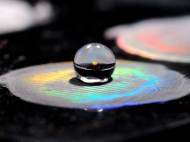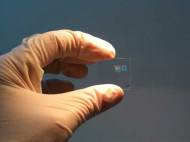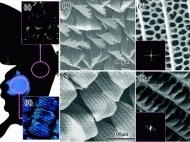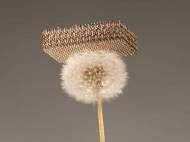
A team of researchers from UC Irvine, HRL Laboratories and the California Institute of Technology has developed the World’s lightest material which is about one hundred times lighter than Styrofoam. Developed for the Defense Advanced Research Projects Agency, the novel material could be used for battery electrodes and acoustic, vibration or shock energy absorption. “Modern…
»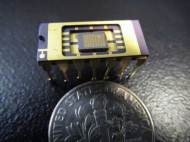
A team of researchers from Stanford University School of Engineering has devised an ultrafast nanoscale light-emitting diode (LED) that is orders of magnitude lower in power consumption than today’s laser-based systems. It is also able to transmit data at the very rapid rate of 10 billion bits per second, making it suitable for use at…
»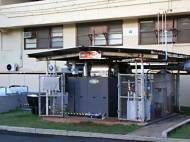
Large navy vehicles can carry several thousands of marines, making them little floating cities. In order to solve the problem with trash at remote forward operating bases (FOB) which burry or burn the waste. In partnership with the Office of Naval Research (ONR), Marines at Camp Smith, Hawaii, are testing a high-tech trash disposal system that…
»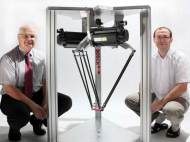
In the early 1980s, the industry was in need for a new type of robot capable to manipulate light and small objects at a very high speed. Since necessity is the mother of invention, Reymond Clavel from the École Polytechnique Fédérale de Lausanne (EPFL) committed to find a solution and came up with the Delta…
»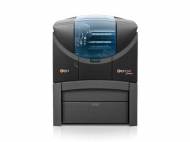
Objet260 Connex is a compact and attractively priced addition to Objet’s family of multi-material 3D printers. Unlike other 3D printers we previously wrote about, the Objet260 Connex is based on the company’s patented inkjet 3D printing technology that enables mixing of 2 different materials to produce a new material with distinct properties, textures and colors….
»
We already published a fair share of articles regarding flying robots, but the robotics team at the Queensland University of Technology (QUT) recently got a grant to develop a couple of interesting robots. They are developing a low-cost flying robot that could be used to inspect the hard to reach places, as well as a…
»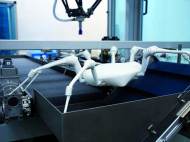
Spiders have inspired a group of researchers from the Fraunhofer Institute for Manufacturing Engineering and Automation IPA to create a mobile robot which looks and moves as spiders. This high-tech assistant is still a prototype, but researchers envision its use as an exploratory tool in environments that are too hazardous or hardly reachable for humans….
»
A team of researchers at the U.S. Department of Energy’s Argonne National Laboratory, discovered that nanotubes composed of titanium dioxide can switch their phase as a battery is cycled, gradually boosting their operational capacity. Laboratory tests showed that batteries produced with this material could be recharged up to half of their original capacity in less…
»