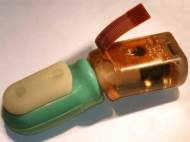
Most flying robots aren’t built to recover from shocks after a collision, but a group of researchers from EPFL decided to construct a robot which is suitable for navigation in cluttered indoor environment. Named AirBurr, the flying robot acts like some flying insects and takes advantage of collisions in order to find its way around…
»
Researchers at the University of South Carolina (USC) Viterbi School of Engineering have designed a robot able to outperform humans in identifying a wide range of natural materials simply by sensing their textures. Named BioTac, the sensing technology could enable robots to ‘feel’ the objects they are interacting with, and it could eventually enable advancements…
»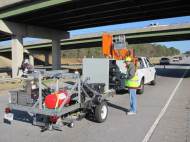
Researchers from Georgia Tech Research Institute (GTRI) recently published new results from a project started back in 2003. They developed a prototype of an automated system able to detect cracks in pavement and seal them. The system is able to detect cracks smaller than 3 mm (one-eighth-inch) wide and efficiently fill cracks from a vehicle…
»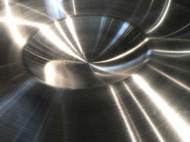
Numerous chemical methods today already enable addition of durable antibacterial properties on surfaces, however, only a few prove to be useful on an industrial scale. Researchers from the University of Liege (ULg), Belgium, recently presented their latest results in a project related to the development of a sustainable way to apply wide spectrum antibacterial properties…
»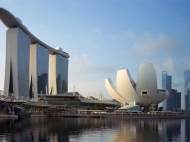
Designed as part of the Marina Bay Sands, the ArtScience Museum is the first museum dedicated to the dynamic interplay between art and science – a concept we cover from time to time in our series about art and technology. Although it doesn’t feature quite as many sustainability solutions as other projects we previously wrote…
»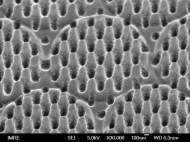
Researchers from A*STAR’s Institute of Materials Research and Engineering (IMRE) and their commercial partners have developed a new plastic able to reflect between 0.09 and 0.2 percent of the visible light hitting its surface. The new plastic developed is also capable to maintain reflectivity lower than 0.7% at angles up to 45˚, thus making it…
»
Syracuse University (SU) researchers found a new way to use nanotechnology in order to harness bioluminescence in a much more efficient way compared to previous experiments. Inspired by firefly (Photinus pyralis), their system achieved 20 to 30 times higher efficiency, thus attaining highest efficiencies in bioluminescence known to date. Once scaled-up and perfected, the system…
»
One of goals in transport is to create vehicles with less weight in order to lower their energy consumption. An EPFL spin-off company named EELCEE has developed a process that allows fast fabrication of lightweight composite components in large quantities. Polymer composites offer a good lightweight alternative to metals while offering the strength of steel….
»