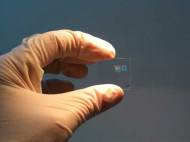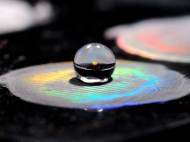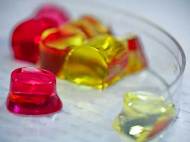
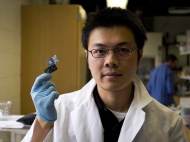
University of California, San Diego bioengineers have developed a smart and easy-to-synthesize self-healing hydrogels that consist of linked chains of polymer molecules which are capable to self-heal in aqueous environment. This jello-like material’s ability to self-heal, bind in seconds and form a bond strong enough to withstand repeated stretching could find uses in biology, medicine,…
»
Inspired by the paper-folding art of origami, chemists at The University of Texas at Austin have developed origami Paper Analytical Device (oPAD) – a low-cost 3D paper sensor that may be able to test for diseases such as malaria and HIV. It can be produced in less than a minute without any tools or special…
»
In their effort to study the effectiveness of haptic technology – technology that takes provides feedback to user’s sense of touch by applying forces, vibrations or motions – researchers from the Vanderbilt University designed an application that could assist visually impaired students to master algebra, geometry, graphing and other subjects that are particularly hard to…
»
In an episode of popular sci-fi series Eureka, meat for the residents was cloned and grown as desired parts of a chicken. Led by a researcher from the Fraunhofer Institute for Process Engineering and Packaging (IVV) in Freising, a group of researchers involved in the EU-project LikeMeat came up with a different approach to solve…
»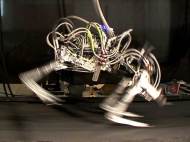
As a part of DARPA’s Maximum Mobility and Manipulation (M3) program, with goal to create and demonstrate significant scientific and engineering advances in robot mobility and manipulation capabilities, engineers from Boston Dynamics developed Cheetah – a robot named after the animal it got inspired from that managed to beat the previous land speed record for…
»
Animals and plants living in snow and sub-zero areas have evolved all sorts of chemical tricks that allow them to live in these cold environments. There are various natural antifreeze compounds from such organisms, but researchers from RIKEN Advanced Science Institute at Wako focused on one called xylomannan – a natural antifreeze produced by the…
»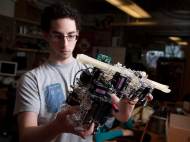
In one of our previous articles, we wrote about two ideas that employ robots building construction, but researchers from Cornell University came up with a different approach in a project named Machine Metabolism – Truss Structure Manipulation using Robots. The project involves a robotic system capable to break down modular elements and reuse them to…
»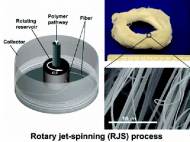
Bioengineers at Harvard University came up with a new technology with a great potential in nanofibers production, and they refer to it as a “cross between a high-speed centrifuge and a cotton candy machine”. The invention could find many uses in industry, with potential applications ranging from artificial organs and tissue regeneration to clothing and…
»